Alexandra Feigin:
The Pillar of Contemporary Bulgarian Figure Skating
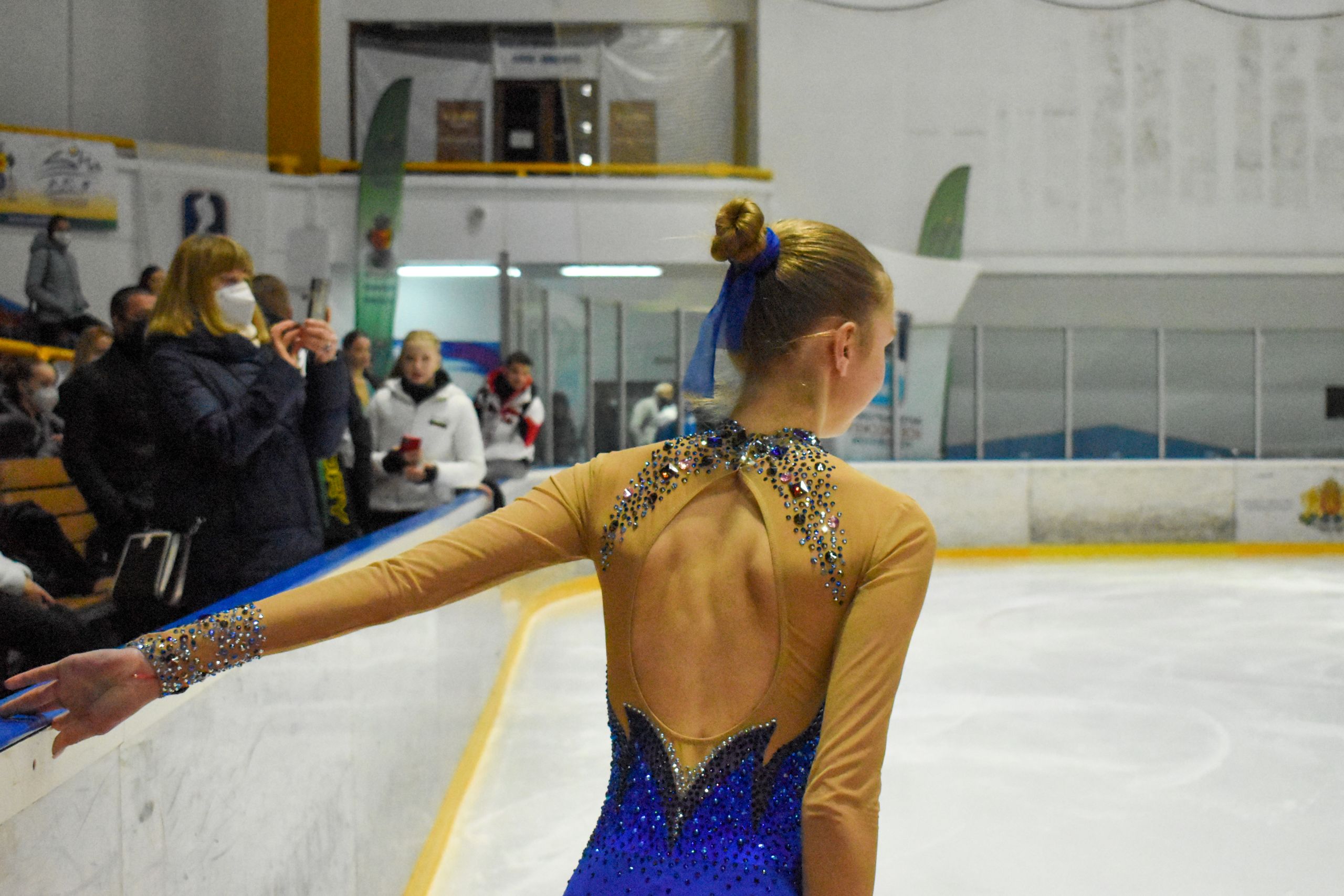

It's 10 AM and it’s the beginning of a long day of training for 18-year-old Bulgarian figure skater Alexandra Feigin.
She is warming up with some very intensive rope jumping which she performs with ease, not even breaking a sweat. In the fast-paced moves of her body, one can notice a logo on the back of her top - “Denkova-Staviski Skating Club''.
It’s a freezing Wednesday morning and skaters are just arriving one by one, just in time for their morning training session. It was a challenge for everyone to be here on time today, as Sofia woke up under a thick blanket of snow in one of the last days of January. A skater wrapped in a giant scarf enters the building. She tells the team the story of how she managed to start her car engine today.
A couple of junior skaters come out of the rink a bit out of breath with their skate gear still on. It must have been their first training session early in the morning. They are followed by the new, promising ice dance couple Mina Zdravkova and Christopher Davis. They are engaged in a conversation about a difficult element they have to execute. Everyone seems to know each other as they greet each other, discuss the schedule for this week, their training, and the snow outside. A small, tight-knit community of athletes.
When entering the ice rink, it is, to put it mildly, cold. The big neon clock on the wall displays that it’s about 3 degrees Celsius. The team warms up around the rink and the sound of skates scratching the surface of the ice gradually intensifies.
All of the skaters are flying across the ice. The sound resembles a gentle winter storm that has suddenly formed around the rink.
Alexandra warms up quickly and goes to take her sweatshirt off and ties her skates tighter.
Alexandra is the two-time Sofia Trophy champion (2019, 2020), the 2019 Denkova-Staviski Cup champion, the 2018 Crystal Skate of Romania champion, a three-time Bulgarian national champion (2017, 2019, 2020), and the face of the European Capital of Sport in 2019. She is also among the top 10 Viasport award-winning, best young athletes in Bulgaria in 2020.
Alexandra has been skating for nearly 12 years. She was born in Israel but grew up in Bulgaria, and like she’s mentioned many times she feels Bulgarian. Her father introduced her to figure skating as well as many other sports such as swimming, diving, rhythmic, and sports gymnastics, which she all practiced when she was younger. At around the age of 8, she made figure skating her focus. She enjoys the difficulty of the sport and that it requires grace and artistry at the same time. She shares that she considers herself an introverted person who doesn't trust easily and relies on her family for support.
Enter coaches Andrei and Ina Lutai - the leaders of the national figure skating team of Bulgaria. They collect the skaters and give them a brief instruction. It looks like it meant: “The usual, guys. Go.” Two minutes later one could hear a loud “Чудесно” (“Wonderful”) coming from Inna, as she watches a skater perform a double axel. She then goes onto the ice to correct a mistake she saw with the corner of her eye. The coach is multitasking, making sure her skaters are doing what they are supposed to do, talking on the phone, and carrying a large Bluetooth speaker to play music for a junior skater who is doing a run-through of her program.
Coach Ina Lutai is a former competitive ice dancer. She competed in the early 2000s together with ice dancer Yuri Kurakin. Today, together with Andrei Lutai, a former competitive solo skater, she is a coach with 12 years of experience. She also does the choreography for many of her skaters’ programs. When asked how she would describe figure skating in one word, she stops to think, smiles, and says: “Oxygen.”
Alexandra is performing difficult combos such as triple lutz-triple toe loop and is very concentrated in every move. Alexandra’s jumps are high, with great flow and landing speed. It is impressive to see her practice.
Her teammate Larry Loupolover executes a quad jump with a bit of wiggle at the end which angers him instantly. Everyone on the ice is very concentrated and focused on every move.
2020 has been incredibly challenging for skaters around the globe as many competitions have been either canceled or postponed and 2021 continues to be uncertain.
To everyone’s disappointment, the 2021 European Championships were canceled at the beginning of January. Although understandable considering the ongoing health crisis, it was difficult news for everyone in the skating community. The pandemic takes its toll on skaters, not only by canceling competitions but also by putting them at a career and life-threatening risk.
Russian skater Anastasia Shpilevaya announced the end of her career after suffering COVID-19. Her body, and muscles weakened after the illness and she had to step off the ice. The two-time Olympic champion Yuzuru Hanyu announced he will not participate in several Japanese and international skating tournaments to avoid the virus.
Alexandra has managed to stay healthy so far and avoid serious injuries but shares that it’s difficult to stay motivated when there are fewer competitions than ever. In an interview in January for NovaTV, Alexandra explained that it is competitions that keep all athletes going: “Competitions give us motivation and without it, training becomes challenging.”
The 2021 World Championships will be the qualifying event for the 2022 Olympic Games in Beijing, China. Alexandra wishes to perform well enough at the World Championships to win a spot. The protocol for earning spots for the upcoming Olympic Games varies from category to category. For the Ladies singles category, all competitors who rank above a certain score after the free program, earn spots. For the medal winners, their countries receive a maximum of three spots. The skaters who are fourth and fifth receive two, and the rest receive one. In this specific instance, the top 17 skaters are going to be eligible for earning a spot for their country. The other and final qualifying event for the Olympic Games is the Nebelhorn Trophy which will take place Sep. 22-25, 2021, in Oberstdorf, Germany.
“This is my biggest dream - to be able to win a spot for the Games, qualify and represent Bulgaria,” says Alexandra.
Alexandra is summoned by Andrey Lutai who gives her a brief instruction and she continues in full force and suddenly, music starts playing and the Moonlight Sonata fills up the arena, and Alexandra starts to practice her new free skating program. She will be performing the program this season, including at the World Championships in Stockholm in March of 2021.
This program was choreographed by Nikita Mikhaylovich and it was done via video only since the Russian borders have been closed since the start of the pandemic in 2020, and Alexandra has been unable to meet him in person.
“It is difficult when your choreographer is not anywhere near you because they cannot correct your mistakes, or show you how to do a certain move. We need to finalize the ending [of the program] and work on a few more details.”
Alexandra recognizes that she has a hard time expressing herself artistically and that it's something she constantly tries to work on and improve. When performing, her mood and state can influence the performance greatly:
“It’s different every time depending on how I am feeling. For example with my short program, the music is from Shindler [Schindler‘s List]. It’s just [perfect] for me because I am a closed-off person, and I don’t express a lot of emotion and that’s why I feel it very close to my heart.”
Coach Ina Lutai reveals that choreographing a new program requires so much than just movement on the ice.
“When creating a program, you have to be careful with the music and concept selection because it’s connected with the temperament of the child. I want every child to be able to tell a story, to connect artistically with the movement on the ice. That is why I give it my best every time. It’s a delicate process that requires many skills,” says Ina.
For an interview for BTV in 2019, Ina Lutai also mentioned that she hopes that Alexandra will get to the level where her performances can tell stories full of emotion and leave the audience in awe.
Alexandra cites Albena Denkova and Maxim Staviski as her choreographers as well. She mentions that whenever they are around, she tries to get as much advice as possible from them.
While artistry makes up a large part of the score, the technical aspect of the performance is equally important.
The latest scoring system works in favor of risk-takers. The higher the risk, the better the score if the element is performed cleanly. The risk includes performing jumps with three to four revolutions in the air.
Each element receives a base value (BV) and a grade of execution (GOE) score from -5 to +5 which focuses on how well it was performed. For example, if a skater performs a triple axel jump but falls on it, they would receive a negative GOE which is deducted from the base value. However, if the skater lands the jump cleanly, they receive a positive GOE. The landing has to be smooth, with good speed and transitions in and out to receive a greater GOE. The triple axel has a base value of 8.00 and if performed well, it can receive a very high mark. Quads can earn over 12 points/jump. The highest GOE score for the triple axel is 4.43, performed by the two-time Olympic champion Yuzuru Hanyu.
Quadruple flip jump by the three-time figure skating World Champion Nathan Chen at the 2017 U.S. National Figure Skating Championships
Alexandra considers her stronger side to be the technical one and she uses her prowess anytime she can, maximizing the points she can receive for a single element. Her favorite jump combination is the 3T-3T.
It’s time for her afternoon skating session where she puts on her self-designed crash pants and starts training some Ultra C jumps. She is going for a quad toe loop and a triple axel - elements that have not been landed in competition by any Bulgarian female skater. They are incredibly difficult and require great coordination. Alexandra hopes to include them in her programs for the Olympic Games. She, however, acknowledges that there is a long way to go.
“When your jump gets consistent, and you have a 10/10 success rate, then you can start thinking about taking the crash pads off. I want to be able to stabilize the jump and put it in a program.”
To stay competitive, Alexandra has to be able to build very solid and technically superior programs, that are complemented by elegance, artistry, and musicality. Not an easy task.
The ladies’ event in figure skating is becoming more and more dynamic as young Russian prodigies start performing quad jumps and triple axels at a very early age. They advance much faster in technique, compared to their peers in other countries. Many skating professionals and enthusiasts criticized the Russian training model because of the many severe injuries young skaters sustain while attempting difficult jumps or trying to keep up with a demanding training schedule. For the past eight years of international competitions, Russian skating stars have come and gone within two years of their senior career. This includes Olympic silver medalist Evgenia Medvedeva who was conquered by Olympic champion Alina Zagitova at the Olympic Games in Pyeongchang, 2018. At the age of 18, Zagitova found herself also unable to compete with her younger, uninjured, and technically superior peers and announced a break from competitive skating. Two-time Finish Olympian Kiira Korpi calls this phenomenon a "vicious cycle".
“There is no longevity in the sport anymore. For example, in the past, fans would follow skaters like Carolina Costner for over 10 years and be everywhere she performs. That was the beautiful thing about our sport. I hope this makes a comeback, and I hope that what we are witnessing today is just a phase or a transition,” says coach Ina Lutai.
The new big names in figure skating on the Russian team include Anna Shcherbakova, Alexandra Trusova, Aliona Kostornaya, and Elizaveta Tuktamysheva. They have been the main victory holders for the past two years because of their technical superiority. Trusova landed her first quad at the age of 13 and unsurprisingly, is known by the nicknames Quad Queen and Russian Rocket. Kostornaya holds the world record for the best short program score because of her triple axel. The oldest one of the group considered a veteran in the sport at the age of 24, Elizaveta Tuktamysheva landed a quad toe loop and executed a clean triple axel in domestic competitions.
While the Russians are expected to do a podium sweep once again at the World Championships this year, Alexandra Feigin is neither discouraged nor demotivated to give it her best. She is learning the same difficult elements but is also attentive to what others in the skating community are doing.
“I try to watch and learn from everyone and take a little something from each person. I don’t look up to one specific skater but I learn from everyone that I can. There is not a single person that has the perfect qualities in every single sense. Every skater has their weaknesses and that’s why I look for the strengths and learn from them.”
3T-3T combo in training by Alexandra Feigin, February 2021
In the meantime, she practices her strongest jumps and combinations every day. Alexandra faced a number of big competitions, including a national championship, Tallink Hotels Cup, Sofia Trophy, and finally, the World Championships in Sweden.
The long day of skating for Alexandra isn't over yet. After 5 PM the same Wednesday in February she switches hats and takes on the role of a junior coach, and meets her little skater trainee.
Alexandra is quick to say she is not strict but is careful when teaching younger skaters the proper technique.
The atmosphere at the rink is different. It's louder and full of kids skaters who are here to learn from elite athletes such as Alexandra. She is watching her trainee closely during the practice and corrects her mistakes as they go.
Alexandra has been thinking about her post-competitive career and she hopes to become a coach and continue to be involved in figure skating. For now, however, she has to use her talent and technical skills to achieve her dream.
“I want to skate clean programs. Everything else — medals, victories, and such, there is no need to be thinking about them now because… well, I am a realist. This is of utmost importance to me. To show what I can do, and let the rest handle itself.”
Figure skating is among the most politically influenced sports. Just a few countries in the world are considered the big players and they medal at almost every international competition. Generally, skaters from smaller countries such as Bulgaria need to work very hard and show their maximum every time in order to climb up the ladder. For many, the dream of medalling internationally remains just a dream. When Alexandra talks about the politics of the sport, she says that if that factor is stripped away, she would be placed close to the top 10 best women in the world.
Ice dancers Albena Denkova and Maxim Staviski remain the only Bulgarian figure skaters to earn a medal at a high level.
A Very Brief History of Bulgarian Figure Skating
Learn more about Bulgarian accomplishments in figure skating here.
It’s March and the start of the biggest event organized by the Denkova-Staviski Club. The name of the international competition taking place in Sofia is Sofia Trophy 2021.
Competitors from 18 countries and various ages are here to show the best they've got. The Winter Sports Palace is full of people and chatter in various languages. Almost every inch of free space is occupied by skaters of all ages who are doing their off-ice jumps. Their sparkly costumes blend in with the rest of their body as they rotate as fast as they can.
During her last competition in Estonia at the Tallink Hotels Cup, received a lower component score and she underrotated a jump which left her off the podium.
Sofia Trophy is her second international competition for the season. The audience consists of competitors mainly and a few parents here and there. Alexandra is set to perform in the last group of senior ladies. Alexandra warms up and gives herself a few moments to tune in before her skate. A solid 10 minutes later, her short program begins. She is skating to the soundtrack from the Schindler’s List film. She is not wearing her traditional gray costume but a burgundy red one.
The story the skater has to portray is the one of war and pain. She executes her jumps with ease and gives a solid performance. She comes off the ice quickly and doesn’t show a lot of emotion. Her coach gives her guards and she puts them on while waiting for the score. She earns 60.23 and is placed first. Alexandra nods at her coach and she leaves the rink. Her job for the day is done.
A few programs later, another contender for the gold enters. Olga Mikutina takes to the ice. She skates clean to the recognizable ‘Sing, sing, sing’. She wins the short program by just 1 point ahead of Alexandra Feigin. This is not the final ranking as the free skate accounts for ⅔ of the score.
The second day of competition begins, and it's time for the free skating to begin. The ice arena at the Winter Sports Palace is different and more lively than ever.
More spectators are taking to their seats this time around. Media officials slowly climb the many tiny stairs and place their gear on a tiny balcony near to what seems to be the Judges’ Room. It’s inspiring to see sports journalists at this event because figure skating is not covered too much in Bulgarian media today.
The room is full of anticipation and excitement for the competition night ahead. A few moments later, a special audience member shows up. The Bulgarian minister of sports Krasen Kralev accompanied by his entourage. He is here to watch Alexandra Feigin perform, as he has done many times in the past.
Alexandra is set to skate in the last group of skaters which consists of medal contenders only. After the warmup, Alexandra seems ready to perform. She starts her new program to Beethoven’s Moonlight Sonata. Everything is going to plan until unexpectedly, Alexandra falls on a triple flip jump. Regardless, she gets up, regroups, and has a clean rest of the program. After the final results are in, she finishes second and is the winner of the silver medal.
When asked how she deals with a fall during a competition, she admits that she needs to regain her mental strength: “When you make a mistake, it means you lost focus. You need to shape up immediately and get back on track.”
Alexandra is happy with her result and goes on to receive her medal with a bright smile on her face. She congratulates the winner Olga Mikutina and is awarded her silver cup by the Bulgarian Sports Minister and the Vice President of the International Skating Union (ISU) - Alexander Lakernik.
Alexandra’s teammates and the audience cheer her on while she takes the last bow at the end of the ceremony.
When talking about Alexandra's consistency and success, Ina shares that Alexandra is a quick learner and a very hard worker.
“When girls reach teenagehood, they are often faced with the challenges of their developing body and some of them quit the sport. However, Alexandra had no such problems. She is very focused and works hard in every single moment.”
So far, Alexandra has achieved the historic 17th place at the 2019 World Championships in Japan. No other Bulgarian woman has reached this ranking.
“Sasha does not leave the rink until she checks off every single task on her list for the day. She knows what she has to do”, says Ina.
The ladies’ category has become more competitive than ever and Alexandra is faced with a tremendous challenge. Coach Ina is confident: ”We will support Sasha in any way we possibly can to help her achieve her dream to go to the Olympics.”
As March comes to an end and the World Championships approach, Alexandra is intensifying her training.
The World Figure Skating Championships 2021 took place in the Ericsson Globe in Stockholm. This arena is special because it is connected to a hotel via a tunnel that ensures all arriving competitors stay in a bubble, go to compete, and go back to their rooms.
Similar to many other tournaments and sports competitions taking place in times of a pandemic, skaters had to follow many rules. One of the rules that was not taken too well by skaters and fans was the ban of hugging and kissing between coaches and competitors at the Kiss & Cry. No spectators were allowed.
Ericsson Globe, Main Ice rink, Stockholm 2021
Although this is an unusual atmosphere for a competition, everyone is willing to follow the rules so that they can compete.
The first few days include training and an opening ceremony. Instagram is blowing up with videos of impressive jumps, spins, and lifts. Fans on Twitter keep track of skating practices and moments behind the scenes. The first practice for the day goes well and men singles stars Nathan Chen and Yuzuru Hanyu appear to be in excellent shape. The Russian trio Alexandra Trusova, Anna Shchrerbakova, and Elizaveta Tuktamysheva also have a solid practice session.
USA's Nathan Chen at the 2021 World Figure Skating Championships
Russia's Alexandra Trusova during the 2021 World Figure Skating Championships
The very next day, the ladies' short program began at 10:55 AM local time. Alexandra is set to compete in Group 5 of the ladies category alongside American pair Bradie Tennell and Karen Chen, Emmy Ma of Chinese Taipei, French Olympian Mae Berenice Meite, and Poland's Ekaterina Kurakova.
Mae Berenice took to the ice in a stunning black costume. No more than 30 seconds later, Mae fell on a toe loop jump and grabbed her ankle. Mae was unable to continue because she just suffered an Achilles tendon rupture. She moved slowly to the exit, skating on her own weight. An emergency team took her on a stretcher and the announcer let the audience know that Mae Berenice of France cannot compete.
France's Mae Berenice Meite leaves the ice and is carried to a stretcher
Alexandra had to go earlier on the ice than expected. The ISU judges gave her a few minutes to warm up, compose herself and gain focus.
An injury such as this one can affect the audience and the other athletes who are yet to skate in the competition. Alexandra looked like she kept her calm or at least didn't express it too much. She performed a clean program and received a score of 59.97 and qualified for free skating.
Alexandra Feigin at the 2021 World Figure Skating Championships | Short Program
Alexandra Feigin at the 2021 World Figure Skating Championships | Short Program
The ladies’ short program event continues to bring surprise after surprise with stunning performances from Russian, Japanese, and American ladies.
Two days later, Alexandra donned a new nocturnal blue costume to fit with her performance. She started her program with a strong 3Lz - 3T combination, followed by a 2A. The performance goes well as Alexandra nails every element from start to finish. She lands her last jump and finishes beautifully with a step sequence and some spins.
The English commentator is impressed by Alexandra’s unique spin position that fits well with the music: "What a fantastic sit spin variation on an outside edge! The element at the end of the program there showed originality and difficulty," he said and continued: "Some very nice choreography toches towards the end of the program."
Alexandra took the audience and judges on a journey through a modern interpretation of the Moonlight Sonata. Alexandra finished 17th and earned a spot for the Olympic Games in Beijing, China in 2022.
“It was wonderful! I did what I had to do - I performed two clean programs and I achieved my biggest goal - to earn a spot for the Olympic games. My coach is so proud of me. He was also nervous during the competition,” says Alexandra with a smile on her face and continues: “When there is a lot of emotion going on, it’s very hard to express it at that moment.”
Alexandra admits that although an audience can enhance performance, the lack of one at the 2021 Championships helped her to relax.
“It was better for me this way because when there’s a big audience, you can feel the atmosphere of a World Championship. Now, it was just us competitors and that helped me feel as if this is just another training session and maybe that’s why I managed to perform well.“
The skater, however, is not absolutely satisfied with the score she received.
“I was a little disappointed because I expected a better score. When you work so hard, you expect to be rewarded for it. But every time you don’t receive the score you deserve, it’s incredibly disappointing. At one point, it becomes offensive.”
The next steps for Alexandra include training, training, and more training.
She will attend a few training camps in summer 2021 and will work on a new short program for the 2021-22 season. She hopes to meet up with other coaches as well to learn new skating skills.
Alexandra confesses that she entered the Championships with the attitude that she wouldn't make it to the '22 Beijing Olympics. But she did.
“I thought my dream wasn’t achievable. When successful sportsmen say that you have to believe in your dream to achieve it, I never understood what that meant. Now that I managed to fulfill my dream I do understand. It’s not only about believing but about hard work too. But most importantly, you need the patience to make it happen. You may not achieve your dream on your first try but it will happen, just work hard.”
This Capstone project was created in 2021 by Katerina Stoyanova, a student at the American University in Bulgaria.
All images & videos not made by the author are the courtesy of other organizations and were used for educational purposes.
 Built with Shorthand